THRILLGROUNDS Before you book · Coasteering & cliff jumpingDeutsch
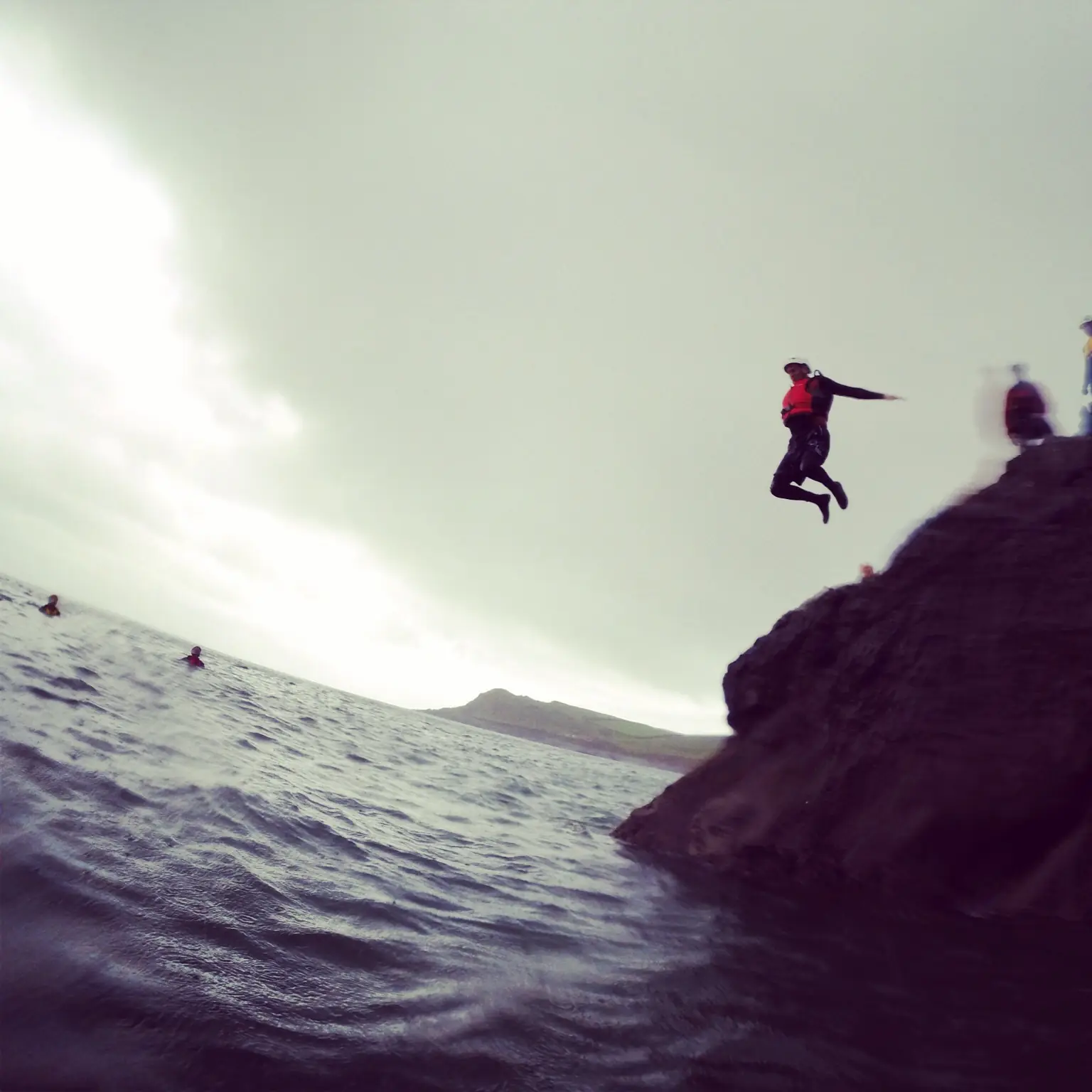
A coasteering jumper in a wetsuit and helmet mid-air off a dark rock ledge into the sea, others swimming below (symbolic image, Gower, not Mallorca)

Guide · 7 grounds · guided and unguided · operators' own rules

Coasteering and cliff jumping: age, swimming, jump heights, cost and safety

Every jump is optional.
The guide's real job is knowing how deep it is.

Coasteering is the sea cliff done from the water side: a guide leads a group in wetsuits, helmets and buoyancy aids along the rocks at the tideline – swimming, scrambling, riding the swell into gullies and jumping from ledges into deep water. It began in Pembrokeshire in the 1980s and is sold today from Wales to Mallorca and Madeira. Cliff jumping without a guide is the same jump without anyone who has checked the depth. Below: the rules of seven grounds word for word – who may go, whether you must swim, how high the ledges are – the cheapest bookable session on each, and what the UK's incident reports and coastguard figures actually say.

Who can go

Operators' own limits on 7 grounds

Age is the only hard rule most operators publish. Guided coasteering starts at 8 almost everywhere – TYF and Tenby in Pembrokeshire, Anglesey, Madeira – with under-16s or under-18s accompanied; TYF's harder routes and Gradient's extreme session start at 16 or 18. Mallorca is the exception in both directions: the kayak-and-cave tour takes children from 6, while the coasteering operator's own age appears as 8, 10 or 12 depending on where you read it. Weight is rarely a rule – TYF has none, Anglesey Adventures stops at 136 kg, the Mallorca operators at 110 kg.

You do not have to be a strong swimmer, but you do have to be comfortable in the sea: a wetsuit and a buoyancy aid keep you up, and Gradient and Anglesey Adventures say so plainly. Tenby asks that you can swim 25 m; Madeira requires basic swimming. And every guided operator on this list says the same about the ledges: every jump is optional, with an easier way into the water. Unguided sites have no rules at all – Rick's Café in Negril answers the question “can I jump?” with “Yes, at your own risk.”

GroundStopWeightAgeAlso
Pembrokeshire & South WalesCoasteering · Abereiddy, St Davids, Tenby and Stackpoleno limit – you must fit the kit8+ (8–15 accompanied); 16+ on the Explorer and Pioneer routesup to 8 people per instructor; jumps optional; Tenby Adventure asks that you can swim 25 m
Snowdonia & North WalesCoasteering · Holy Island, Angleseymax. 136 kg (300 lb)8+; not over 70you need not be a strong swimmer; not with pregnancy, back or heart problems or recent surgery; jumps up to 10 m+, all optional (Gradient Adventure)
MallorcaCoasteering · the cliffs of La Victòria and Bonaire, Alcúdia; also the south coastmax. 110 kg (243 lb)10+ on the operator's own site – GetYourGuide says 12, Viator 8jumps from 3 to 12 m; not with back problems; in Alcúdia (NoFrills) 2–10 m, “all cliff jumps are completely optional”
MallorcaKayak, sea cave and cliff jumpmax. 110 kg – the kayaks' limit6+ with an adult (GetYourGuide: from 5)the cliff jump is optional; swimming recommended but not mandatory; helmet, life jacket and wetsuit provided, safety boat
MadeiraCoasteeringnot published8+basic swimming required; main jump 10 m and always optional (GetYourGuide says 11–13 m); not with back or heart problems
BaliCliff jumping · Aling-Aling, Sambangannot publishednot publishedjumps of 5, 10 and about 15 m and a 12 m rock slide; a local guide is compulsory for jumping and sliding; life jacket provided
JamaicaCliff jump · West End, Negril–not publishedunguided: three ledges at 3, 7.6 and 10.6 m, water 4.5 m deep, “at your own risk”; free entry

What it costs

Cheapest bookable offer per ground, as retrieved Sept 29, 2026

A guided half day costs €50–95 on the booking platforms: about €52 at Stackpole Quay in Pembrokeshire, €54 on Madeira, €62–75 on Mallorca, €80–95 on Anglesey. Booked direct in Wales it is £45–65 (Outer Reef and Gradient from £45, Tenby Adventure £55, TYF £65). Mallorca's kayak, sea-cave and cliff-jump tour runs about €67. Bali's waterfall jumps are the cheap end: under $20 with a local guide from the north coast. Rick's Café charges nothing for the jump – you pay for the drinks, or for the day trip from Montego Bay. The table lists the cheapest bookable offer per ground.

How dangerous is it

Coasteering is one of the few activities here with its own incident register. The UK's National Coasteering Charter, founded in 2011 by about 80 providers with the RNLI and RoSPA and now over 400 members, collected 146 reports from 2012 to 2024: 104 accidents and 2 deaths. The most common cause was the landing – the moment you hit the water – followed by falls on the rocks; back and neck injuries included three spinal fractures. Reporting is voluntary, so these are minimums. One of the deaths was on a guided session: a 49-year-old weak swimmer drowned at Dancing Ledge in Dorset in 2019, and the inquest questioned groups led by a single guide and asked that providers check how well people swim (Swanage News). In the UK, coasteering for under-18s needs an adventure-activities licence; adult-only groups do not.

The unguided version is where the coastguard numbers come from. Since 2004 HM Coastguard has dealt with over 200 “tombstoning” incidents, 70 injuries and 20 deaths; RoSPA's rule of thumb is that a 10 m jump needs at least 5 m of water – “but this cannot be relied upon”, because the tide changes the depth by the hour. The physics are unforgiving: from 10 m you hit the water at about 50 km/h, from 15 m at about 60 km/h (our calculation). A 2022 study put the injury threshold at roughly 8 m head-first, 12 m hands-first and 15 m feet-first. So: feet first, arms in, and only where someone has checked the depth that day.

146incident reports · UK coasteering 2012–2024

104 accidents, 58 incidents and 23 near misses reported to the National Coasteering Charter, including 2 deaths. Top cause: landing and water entry (32 accidents). Back and neck injuries: 23, among them 3 spinal fractures. Reporting is voluntary – the Charter calls its own figures an underestimate.

Source: National Coasteering Charter, Accident, incident and near-miss statistics 2012–2024

20tombstoning deaths · UK coast since 2004

HM Coastguard has dealt with over 200 incidents of people jumping from cliffs, piers and harbour walls, with 70 injuries and 20 deaths; the injured were aged 12 to 45. RoSPA's older count for 2004–2008 alone: 139 rescues, 12 deaths.

Source: Maritime and Coastguard Agency, Tombstoning (gov.uk)

8 minjury threshold head-first

Hydrodynamic study of water entry: the estimated critical height for injury is about 8 m head-first (neck and spine), 12 m hands-first (collarbone) and 15 m feet-first (knees). Most coasteering ledges are below that; the top ledge at Rick's Café is 10.6 m.

Source: Pandey et al., Science Advances 2022

What to wear

Source: Operators: TYF, Tenby Adventure, Gradient Adventure; National Coasteering Charter, Safety Advice for Coasteering Providers (V6, 2026)

First time

Before you go

What is coasteering?

A guided route along a rocky coastline at the waterline: swimming, scrambling over rocks, riding swells into gullies and jumping from ledges into deep water, in a wetsuit, helmet and buoyancy aid. It started in Pembrokeshire, Wales, in the mid-1980s.

Do you need to be able to swim?

Not strongly, but you must be comfortable in the sea. Gradient Adventure and Anglesey Adventures say you need not be a strong swimmer because the wetsuit and buoyancy aid keep you afloat; Tenby Adventure asks that you can swim 25 m, Remote Madeira requires basic swimming. Be honest with the guide about your level.

How old do you have to be?

Usually 8 – TYF, Tenby, Anglesey and Madeira – with under-16s or under-18s accompanied. TYF's harder routes start at 16. On Mallorca the kayak-and-cave tour takes children from 6; the coasteering operator's age is given as 8, 10 or 12 depending on the listing, so check before you book.

How high are the jumps?

From a metre or two up to about 10 m on most guided sessions – Gradient on Anglesey and Remote Madeira top out around 10 m, Mallorca 10–12 m. Every guided operator here makes all jumps optional. Unguided sites go higher: Rick's Café's top ledge is 10.6 m, Aling-Aling's about 15 m.

Is coasteering dangerous?

It has recorded accidents: 104 in the UK's voluntary register from 2012 to 2024, including two deaths, most often at the landing. Unguided cliff jumping is much worse – 20 deaths and 70 injuries on the UK coast since 2004. The difference is a guide who knows the site and checks the depth; go with one.

How much does it cost?

About €50–95 for a guided half day on the booking platforms, £45–65 booked direct in Wales, around €67 for Mallorca's kayak and cliff-jump tour and under $20 for Bali's guided waterfall jumps. Rick's Café in Negril is free.

How deep does the water need to be?

RoSPA's rule of thumb is at least half the jump height – 5 m of water under a 10 m jump – but the tide changes depths by the hour and rocks sit just below the surface. That is why guides check depth before every jump from height.