0.45deaths per 100,000 commercial boaters · US 1994–98
Against 2.25 for private boaters and 0.86 overall, from a study of 30 managed US whitewater rivers with counted use.
Source: American Whitewater, “Whitewater is Safer Than You Think”
Guide · 12 rivers · 12 grounds · operators' own rules
The river sets the minimum age.
The class tells you which river.
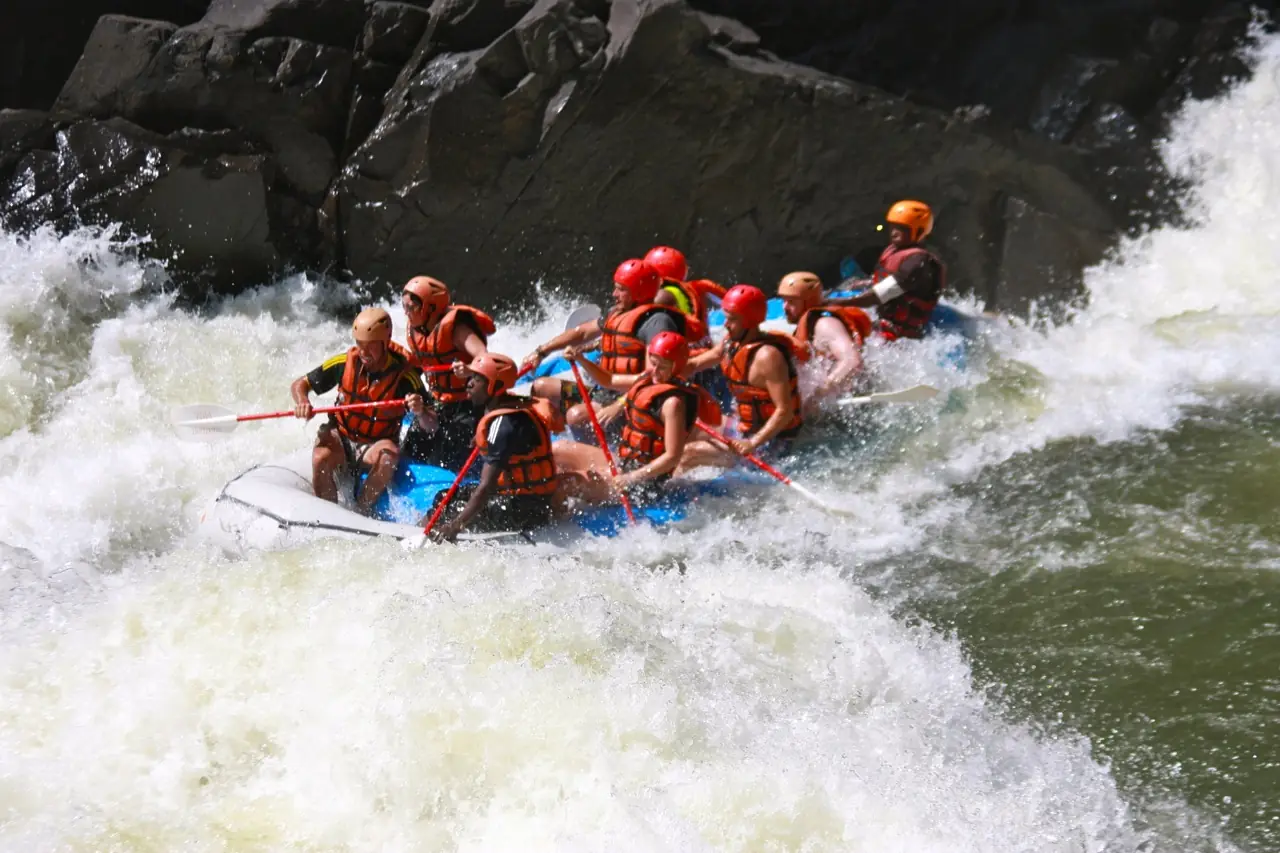
Rafting has no weight limit worth the name – the raft carries eight – but it has the strictest age rules of any activity on these grounds, and they follow the water: 3 on a Class 1–2 float, 6–8 on Class 2–3, 12–13 on Class 3–4, 15 on the Grade 5 Zambezi. This guide lists the operators' rules on every river we have built, what a trip costs, and the best-measured safety figure in adventure sport: deaths per 100,000 user days.
Operators' own limits on 12 grounds
The class is the rule. The international scale runs from Class 1 (moving water) to Class 5 (violent, expert); commercial trips stop at 5. Operators set the minimum age by the hardest rapid on the run: 3–5 for Class 1–2 floats (Lower Pigeon, Fisher Towers), 6–8 for Class 2–3 (Snake River, Soča, Ayung, Upper Pigeon), 12–13 for Class 3–4 (Pacuare, Elaho, Kicking Horse, Royal Gorge) and 13–15 for Grade 5 (Kaituna, Zambezi). Where the same river has a family stretch, the age drops with it. Minimums move with the water: Colorado outfitters raise the Royal Gorge to 15–16 at spring high flow.
Weight is rarely capped – Glacier Raft's roughly 300 lb is about wetsuit and life-jacket sizes – but minimum weights of 40–110 lb are common on the harder runs so the life jacket fits and a child can be pulled back in. Swimming ability is “recommended but not mandatory” at most outfitters; tell the guide, and you sit in the middle.
Cheapest bookable offer per ground, as retrieved Sept 25, 2026
The cheapest whitewater on our grounds is in Bali – Ayung River trips from about $16–26 with lunch. Europe runs €50–70 (Soča, Inn), North America $85–175 for the big Class 3–5 days (Royal Gorge, Kicking Horse, Elaho), the Zambezi about $140–175. Wetsuits, helmets and life jackets are always included; photos usually are not.
Rafting has the best-measured risk in adventure sport because rivers are managed and counted. American Whitewater's study of 30 managed US rivers found 0.86 whitewater deaths per 100,000 boaters over 1994–1998 – but split it and the picture changes: 2.25 for private boaters, 0.45 for commercial ones. A 2003 review in Wilderness & Environmental Medicine put commercial rafting at 0.55 deaths per 100,000 user days, citing West Virginia's 11 fatalities in roughly two million commercial rafters between 1984 and 1999. For scale, American Whitewater's comparison table puts scuba diving at 3.5 and swimming at 2.6 per 100,000 participants. Injuries are mostly paddles in faces and knocks while swimming a rapid; the drownings that do occur cluster at high water and on the hardest runs – which is exactly what the age minimums are for.
0.45deaths per 100,000 commercial boaters · US 1994–98
Against 2.25 for private boaters and 0.86 overall, from a study of 30 managed US whitewater rivers with counted use.
Source: American Whitewater, “Whitewater is Safer Than You Think”
0.55rafting deaths per 100,000 user days
Kayaking 2.9. Rafting injury rate 0.26–2.1 per 100,000 boating days; West Virginia recorded 11 deaths in about two million commercial rafters, 1984–1999.
Source: Fiore D. C., Wilderness & Environmental Medicine 2003;14:255–60
3.5scuba deaths per 100,000 participants, for comparison
American Whitewater's 1998 comparison table: scuba 3.5, climbing 3.2, whitewater kayaking 2.9, swimming 2.6, bicycling 1.6.
Source: American Whitewater, Chart 3 (National Safety Council data)
Source: Glacier Raft Company, FAQs; New Mexico River Adventures; REI
It follows the river class: from 3 on Class 1–2 floats (Lower Pigeon), 5–8 on Class 2–3 (Fisher Towers, Soča, Snake River, Ayung, Upper Pigeon), 12–13 on Class 3–4 (Pacuare, Kicking Horse, Elaho, Royal Gorge) and 13–15 on Grade 5 (Kaituna, Zambezi). Many outfitters also set a minimum weight of 40–110 lb so the life jacket fits, and raise the age at spring high water.
Rarely a maximum – Glacier Raft quotes about 300 lb, set by wetsuit and jacket sizes. Minimums are the real rule: 40 lb at Fisher Towers, 50–90 lb on the Kicking Horse, 70 lb on the Upper Pigeon, 90 lb on the Elaho, 110 lb on the Pacuare.
From about $16–26 in Bali to €50–70 in the Alps and $85–175 for the big North American Class 3–5 days; the Zambezi is $140–175. Wetsuits, helmets and life jackets are included everywhere. See the price table above.
Commercial rafting runs at about 0.45–0.55 deaths per 100,000 user days in the US studies – a quarter of the private-boater rate and well below scuba diving (3.5) or swimming (2.6 per 100,000 participants). Injuries are mostly bumps and paddle knocks; the serious accidents cluster at high water on the hardest runs, which is why the age minimums rise with the class.
Most outfitters say “recommended but not mandatory”: you wear a life jacket throughout and the guide positions non-swimmers in the middle of the raft. On Grade 5 rivers – Kaituna, Zambezi – be honest about it at booking.
Swimsuit and a towel on cold rivers, where the outfitter issues wetsuit, jacket, boots and helmet; quick-drying synthetics (no cotton) and shoes with a heel strap on warm ones. Sunscreen, a strap for glasses, nothing in your pockets.
Ranked by the numbers: Whitewater rafting rivers compared by class →